

How To Set Up A Backgammon Board To Play

| Setup | ||
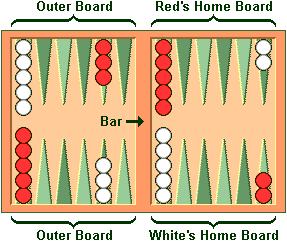
| Backgammon is a game for two players, played on a lath consisting of twenty-4 narrow triangles called points. The triangles alternate in color and are grouped into four quadrants of six triangles each. The quadrants are referred to as a player's home board and outer board, and the opponent'south dwelling board and outer board. The dwelling house and outer boards are separated from each other by a ridge downwardly the centre of the board chosen the bar.
The points are numbered for either player starting in that histrion'southward abode lath. The outermost point is the xx-four signal, which is also the opponent'due south one point. Each player has 15 checkers of his own color. The initial arrangement of checkers is: 2 on each histrion's twenty-four point, v on each histrion's thirteen point, three on each histrion'due south 8 indicate, and five on each player'southward half dozen point. |
 Both players take their own pair of dice and a die cup used for shaking. A doubling cube, with the numerals 2, four, viii, 16, 32, and 64 on its faces, is used to keep track of the electric current pale of the game.

| Object of the Game | ||
| The object of the game is movement all your checkers into your own domicile board and then bear them off. The first role player to carry off all of their checkers wins the game.
|
| Movement of the Checkers |
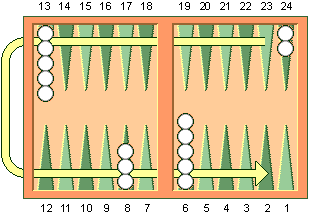
| To start the game, each player throws a single die. This determines both the actor to become start and the numbers to be played. If equal numbers come up up, then both players roll once again until they roll dissimilar numbers. The thespian throwing the higher number at present moves his checkers according to the numbers showing on both dice. After the first whorl, the players throw two dice and alternating turns. The roll of the dice indicates how many points, or pips, the role player is to motility his checkers. The checkers are always moved forwards, to a lower-numbered point. The following rules apply:
|
| Hitting and Entering |
| A point occupied past a single checker of either colour is called a blot. If an opposing checker lands on a blot, the blot is hit and placed on the bar. Whatsoever time a actor has one or more than checkers on the bar, his first obligation is to enter those checker(s) into the opposing dwelling board. A checker is entered by moving information technology to an open point corresponding to one of the numbers on the rolled die. For example, if a player rolls four and 6, he may enter a checker onto either the opponent'due south four point or six indicate, so long as the prospective betoken is non occupied by two or more of the opponent's checkers. If neither of the points is open, the player loses his turn. If a histrion is able to enter some but not all of his checkers, he must enter every bit many as he can and so forfeit the remainder of his turn. After the concluding of a actor'south checkers has been entered, any unused numbers on the die must be played, by moving either the checker that was entered or a different checker. |
| Begetting Off |
| Once a histrion has moved all of his xv checkers into his home board, he may commence bearing off. A player bears off a checker by rolling a number that corresponds to the point on which the checker resides, and then removing that checker from the board. Thus, rolling a 6 permits the player to remove a checker from the six bespeak. If there is no checker on the point indicated by the scroll, the player must make a legal move using a checker on a higher-numbered bespeak. If there are no checkers on higher-numbered points, the player is permitted (and required) to remove a checker from the highest signal on which ane of his checkers resides. A player is under no obligation to bear off if he can make an otherwise legal move. A player must accept all of his active checkers in his home board in society to bear off. If a checker is hit during the bear-off process, the thespian must bring that checker back to his home board before continuing to bear off. The first player to comport off all 15 checkers wins the game. |
| Doubling |
| Backgammon is played for an agreed pale per signal. Each game starts at one point. During the class of the game, a player who feels he has a sufficient advantage may propose doubling the stakes. He may practise this only at the commencement of his own plow and before he has rolled the dice. A histrion who is offered a double may reject, in which case he concedes the game and pays one betoken. Otherwise, he must accept the double and play on for the new higher stakes. A actor who accepts a double becomes the owner of the cube and simply he may make the adjacent double. Subsequent doubles in the same game are called redoubles. If a thespian refuses a redouble, he must pay the number of points that were at stake prior to the redouble. Otherwise, he becomes the new owner of the cube and the game continues at twice the previous stakes. There is no limit to the number of redoubles in a game. |
| Gammons and Backgammons |
| At the end of the game, if the losing role player has borne off at least one checker, he loses only the value showing on the doubling cube (1 point, if in that location accept been no doubles). All the same, if the loser has not borne off whatever of his checkers, he is gammoned and loses twice the value of the doubling cube. Or, worse, if the loser has not borne off any of his checkers and all the same has a checker on the bar or in the winner's dwelling house board, he is backgammoned and loses three times the value of the doubling cube. |
| Optional Rules |
| The following optional rules are in widespread use.
|
| Irregularities |
|
Mutual Questions
- Can I pass when information technology's my plough?
- Tin can I play i number in such a way as to avoid playing the other?
- What if I tin but play 1 number?
- Is hit-and-run allowed (likewise known as "choice and pass")?
- Is information technology ok to have more than five checkers on a indicate?
- Tin I play low number first when begetting off?
- Is stalemate possible in backgammon?
Other Games
- How do you play Acey-Deucey?
- What is Nackgammon?
- What is hyper-backgammon?
- What is long-gammon?
- What is roll-over?
- More games ...
Forms of Competition
- What is a chouette?
- What is match play?

Return to: Backgammon Galore

How To Set Up A Backgammon Board To Play,
Source: https://www.bkgm.com/rules.html
Posted by: vegatunised.blogspot.com
0 Response to "How To Set Up A Backgammon Board To Play"
Post a Comment